“GMP”
Evidence →“GMP-certified” describes factory processes, not what is in the bottle. The claim does not name a certifier or public register that a shopper can check.
Checked against public sources between July 23 and July 24, 2026 · LookCloser does not sell or recommend supplements.
Does the marketing hold up?
Ingredient amounts are hidden inside “Test X180® Testosterone Support Matrix”. The panel lists “Test X180® Testosterone Support Matrix” (600 mg) as a combined amount. A blend total can’t tell you whether any single ingredient reaches a dose used in research.
“Couldn’t verify” means we looked and found no public proof — not a mark against the product. Most supplement claims cannot be independently verified by anyone, so grey is the normal state of this industry.
| Calories | 30 |
|---|---|
| Total Carbohydrate | 8 g |
| Total Sugars | 4 g |
| Vitamin D (as Cholecalciferol) | 84 mcg |
| Sodium (as Sodium Citrate) | 10 mg |
| Test X180® Testosterone Support Matrix | 600 mg |
| S7® Nitric Oxide System | 50 mg |
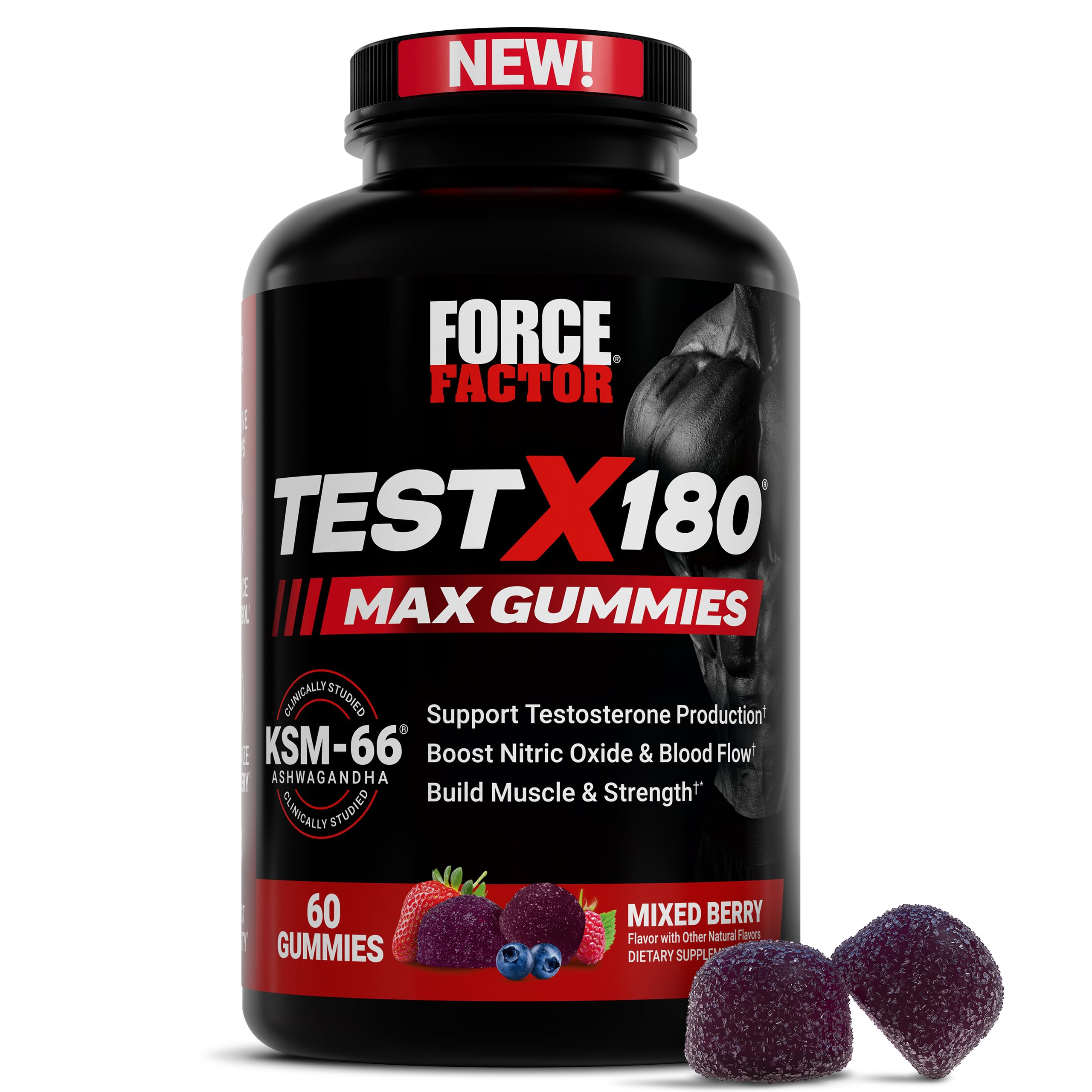
Printed on the package: CLINICALLY STUDIED · GMP · KSM-66 · Third-Party Tested · GMP-Compliant
We read 7 lines from the package photograph. It is our transcript of the label, not the manufacturer’s panel, and it may be incomplete.
1 promise needs a closer look.
“GMP-certified” describes factory processes, not what is in the bottle. The claim does not name a certifier or public register that a shopper can check.
Ingredient research can support context, but it is not a trial of this exact product.
We found no named, citable study of this product or formula. The claim may rest on ingredient research rather than a trial of this product.
No named laboratory or lot-specific certificate was found for this exact product. The exact brand page names no testing issuer and links no product-bound report. Under NSF/ANSI 173, NSF lists Force Factor, LLC products, including Force Factor® Creatine Monohydrate Gummies, Assorted Flavors, but not this exact SKU. IFOS, USP, and Informed-Sport were not checked in this record. This is a public-evidence limit, not a finding that testing did not occur.
We looked and found no public proof. That does not count against the product.
Headlines first. Open evidence only when you want the source trail.
This is category history, not proof about this product, but it changes how much unsupported claims deserve to be trusted.
FDA's health-fraud program documents sexual-enhancement products as the most common supplement category found to contain undeclared prescription-drug ingredients. This is a category-level documented fact from FDA's public database — not a test result for this specific product. …
Locked evidence record →Open the full source-linked findingThe public ownership record is ambiguous. We show the exact candidates instead of choosing one by name similarity.
USPTO returned multiple live supplement-class records for the exact brand wordmark: Hungry Fish Media, LLC, Force Factor Brands LLC. These records answer who owns registrations for the brand; the separate product-to-owner or manufacturer link remains open.
Locked evidence record →Open the full source-linked findingThe barcode matches, so we are checking the right product rather than a look-alike.
The brand's store lists this exact barcode as “Test X180 Max Gummies” (variant: Default Title) — identity confirmed across retailer listings.
Locked evidence record →Open the full source-linked findingThese are evidence gaps, not strikes against the product.
These are the USPTO records behind the brand name. We show them all rather than choosing one by similarity.
DELAWARE, USA · Registration 3786044
24 School Street, Suite 301, Boston, MASSACHUSETTS 021085139, UNITED STATES
IC 005: Vitamin and mineral supplements; Vitamin supplements.
Delaware, USA · Registration 8142487
332 Congress Street, Suite 200, Boston, Massachusetts 02210, UNITED STATES
IC 032: Energy drinks; Sports drinks containing electrolytes; Powders for making energy drinks.; IC 005: Dietary and nutritional supplements.
This answers who owns registrations for the brand wordmark. It does not by itself prove which entity made, imported, or sold this specific product. Open USPTO source ↗
We could not match an amount on this product to a studied range for the same ingredient, so these links are ingredient background rather than a measurement of this product.
$1.00 per labeled serving
matching UPC/GTIN · checked Aug 29, 2026
View on Amazon ↗$1.00 per labeled serving
matching UPC/GTIN · checked Jul 24, 2026
View on iHerb ↗We only show a price when the seller publishes the same barcode as the bottle. We haven’t found that match here.
Search Target ↗We only show a price when the seller publishes the same barcode as the bottle. We haven’t found that match here.
Search Walmart ↗Same UPC/GTIN observed across 2 sellers at the same price at check time.
Reference prices only · no affiliate links · every compared seller must publish the matching UPC/GTIN.
The full report shows every source, the exact unresolved question, and the documentation that would settle it.
Record built September 03, 2026. Sources: source listing observed at check time · USPTO Trademark Search · Keepa exact-listing history · NIH / published research · certification and regulator records where available. LookCloser publishes evidence and gaps; it does not advise for or against any supplement. Evidence-based corrections welcome.