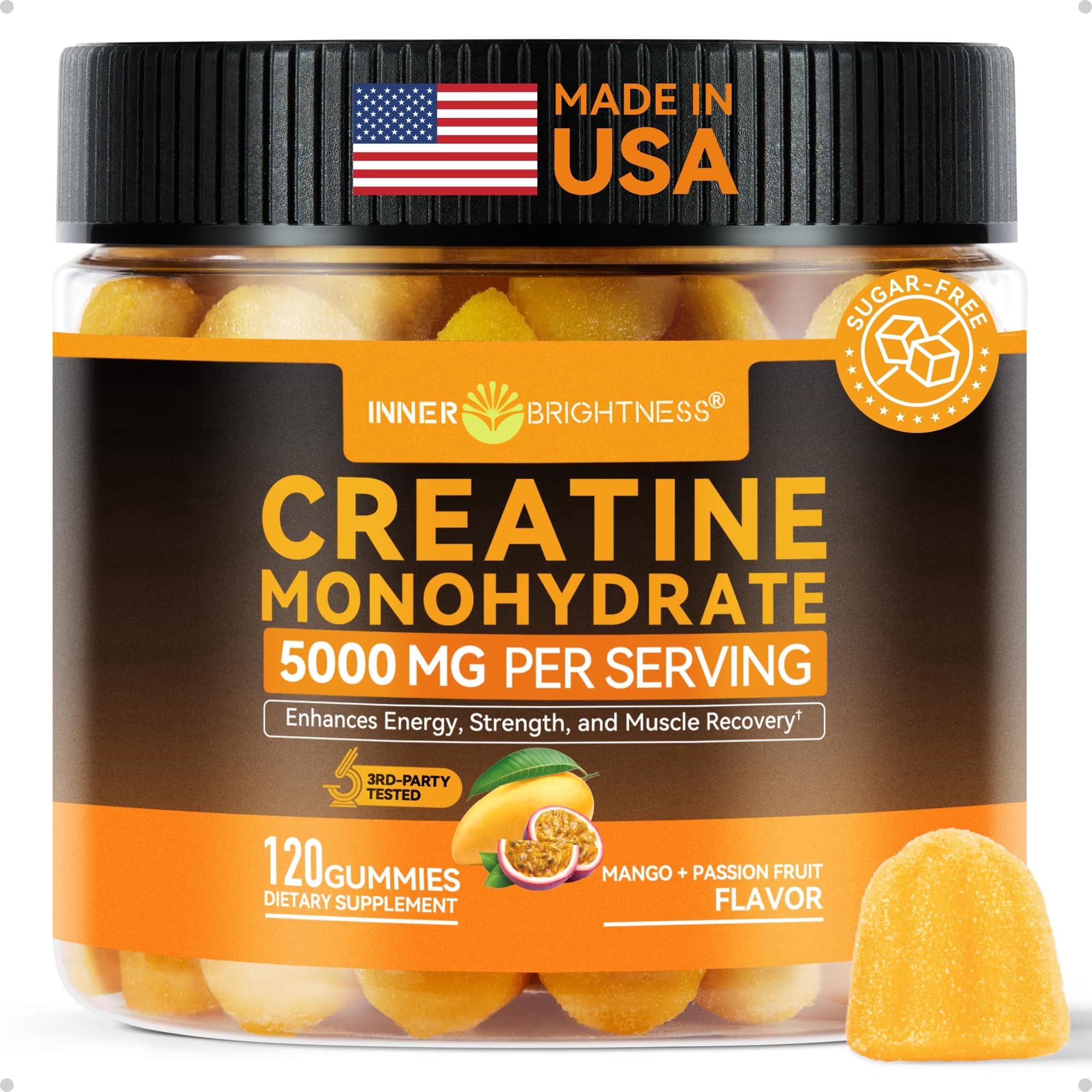
Exact product checked · GTIN 00850074964254Inner Brightness · checked Jul 21, 2026 · on sale since Aug 22, 2025🇺🇸 USPTO wordmark owner · Bright Concept Branding Inc. · NEW YORK, USA; WYOMING, USAPackage says distributed by: Inner Brightness LLC · Blvd, Tustin, CA 92780
-9622
Quick read · Inner Brightness
Inner Brightness Creatine Monohydrate Gummies for Men & Women…
Checked against public sources between July 21 and September 1, 2026 · LookCloser does not sell or recommend supplements.
120gummies · 30 servings
4.2 / 5rating at observation
1,821visible ratings
Does the marketing hold up?
The label says 14 g of creatine in 4 gummies — but not what those 4 gummies weigh. That weight is the one number that would let anyone check the amount on the front. We did not weigh it ourselves, so this is an open question, not a problem we found.
Is the dose real?Panel read — dose not verified5 ingredients listed; no advertised amount we could confirm against them
What a serving costsNo price found for this exact barcode
Is it tested?Claimed — no lab or certificate found
Who’s behind it?🇺🇸Bright Concept Branding Inc.corporation; limited liability company · NEW YORK, USA; WYOMING, USA
Is it the real thing?✓Barcode matches outside records
Trouble on record?✓No recalls found
“Couldn’t verify” means we looked and found no public proof — not a mark against the product. Most supplement claims cannot be independently verified by anyone, so grey is the normal state of this industry.
2◖ partly confirmed2? couldn’t verifyno contradictions · no recalls
The label itself
What the Supplement Facts panel says
Serving size 4 Gummies · 30 servings per container
Calories
31
Total Carbohydrate
9 g
Total Sugars
0 g
Includes Added Sugars
0 g
Creatine Monohydrate
5000 mg
Printed on the package:MADE IN USA · SUGAR-FREE · 3RD-PARTY TESTED · DIETARY SUPPLEMENT · THIRD-PARTY LAB TESTED · GMP Quality Practice · 3RD PARTY LAB TESTED
We read 5 lines from the package photograph. It is our transcript of the label, not the manufacturer’s panel, and it may be incomplete.
Marketing claims, checked
The checks, one by one
The public sources did not settle the marketing promises on this label.
◐Partly confirmed2
“Inner Brightness Creatine Monohydrate Gummies for Men & Women 5000 mg, 3rd Party Tested, Creatine Chews for Muscle Growth, Strength & Energy…”
The panel lists 5 g creatine per serving, at the top of the commonly studied 3–5 g/day range. This compares listed label numbers with research; it does not verify contents or recommend an amount.
“GMP-certified” describes factory processes, not what is in the bottle. The claim does not name a certifier or public register that a shopper can check.
“Inner Brightness Creatine Monohydrate Gummies for Men & Women 5000 mg, 3rd Party Tested, Creatine Chews for Muscle Growth, Strength & Energy…”
No named laboratory or lot-specific certificate was found for this exact product. A related brand page repeats a testing claim but names no issuer; its UPC is not published. NSF, IFOS, USP, and Informed-Sport were not checked in this record. This is a public-evidence limit, not a finding that testing did not occur.
We looked and found no public proof. That does not count against the product.
Quick read · 4 useful findings
What is worth knowing.
Headlines first. Open evidence only when you want the source trail.
Needs explanationIs the label honest?
The label says 14 g of creatine in 4 gummies — but not what those 4 gummies weigh
That weight is the one number that would let anyone check the amount on the front. We did not weigh it ourselves, so this is an open question, not a problem we found.
Evidence and sources
A serving is 4 gummies, and the panel lists 14,000 mg — 14 g — of creatine in that serving. What the panel doesn’t give is the one number needed to check it: what a serving weighs. Gummies of this type usually run somewhere around 2.5 to 3.5 grams each, which would put 4 of…
Creatine in a gummy can degrade in moist, acidic conditions.
Moist, acidic formats can reduce the active ingredient over time, so the delivered amount may be lower than the label says.
Evidence and sources
Creatine is stable as dry powder, while published stability research shows faster degradation as moisture and temperature rise. A gummy's delivered amount therefore depends on formulation and shelf-life testing; this record does not test this product.
Reviews rose from 0 to 98 between October 3, 2025 and August 22, 2026 — no sudden jump.
A count that moves steadily is ordinary. A sudden burst is what deserves a closer look.
Evidence and sources
Written reviews rose from 0 to 98 between October 3, 2025 and August 22, 2026. The largest rise inside any single 30-day window was about 16, so the count moved in steps rather than in one burst.
No FDA recall matched this brand in the current search.
We have not found a public label filing for this exact product.
Barcode checksum is valid; no independent product record was found.
These are evidence gaps, not strikes against the product.
Who owns the brand wordmark?
🇺🇸
Bright Concept Branding Inc.Corporation; Limited Liability Company · exact supplement-class mark for INNER BRIGHTNESS
Registration6568296
Registered2021-11-23
AssignmentsYes
Filed address Apt. C1, 43 Underhill Avenue, Brooklyn, NEW YORK 11238, UNITED STATES
USPTO identifies the public owner or applicant behind this brand wordmark. This does not by itself identify the product manufacturer or prove where the product was made. Open USPTO source ↗
Research behind the findings
Dose and research context
The label amount is shown beside the range used in the linked ingredient studies.
Dose vs research
Creatine
STUDIED RANGE06.25 g
5 g per serving — within the 3–5 g/day used in the linked studies.
Linked ingredient research · label amount, not a recommendation
Not a score. Studies disagree with each other and change over time, so this sits beside the evidence rather than counting toward it — it is here so you can read the sources yourself.
The panel lists 5 g of creatine monohydrate per serving. Studies we found used 3 g–5 g a day, so this sits inside that range.
0studied 3 g–5 g
Study ranges differ between trials and change as research changes. This is background reading, not a pass, a failure, or a recommendation.
Open related seller leads before buying, then confirm the flavor, count, and serving size. Their prices are visible, but LookCloser does not claim savings until the pages share a UPC/GTIN.
Amazon
Submitted listing
No price confirmed
No current offer was available via Keepa on 2026-09-01.
Useful official shopping lead; excluded from exact price comparisons.
Creatine Monohydrate Gummies for Men & Women 5000 mg, 3rd Party Tested, Creatine Chews for Muscle Growth, Strength & Energy Support, Sugar Free, Vegan, 120 Count, Mango Passionfruit · Default Title. The page matches 5000 mg, 120 count, 5 g, but omits the identifier needed to bind the exact sellable unit.
Related brand page publishes 4.7/5 across 5 reviews
The related page's review pool may differ from the observed listing. Because the page does not publish a matching UPC/GTIN, LookCloser does not attribute that review aggregate to this exact sellable unit.
Prices and stock are point-in-time observations. Related pages are never used as product evidence. No affiliate links; LookCloser earns nothing from these sellers.
Want to inspect the evidence?
The full report shows every source, the exact unresolved question, and the documentation that would settle it.
Record built September 03, 2026. Sources: source listing observed at check time · USPTO Trademark Search · Keepa exact-listing history · NIH / published research · certification and regulator records where available. LookCloser publishes evidence and gaps; it does not advise for or against any supplement. Evidence-based corrections welcome.