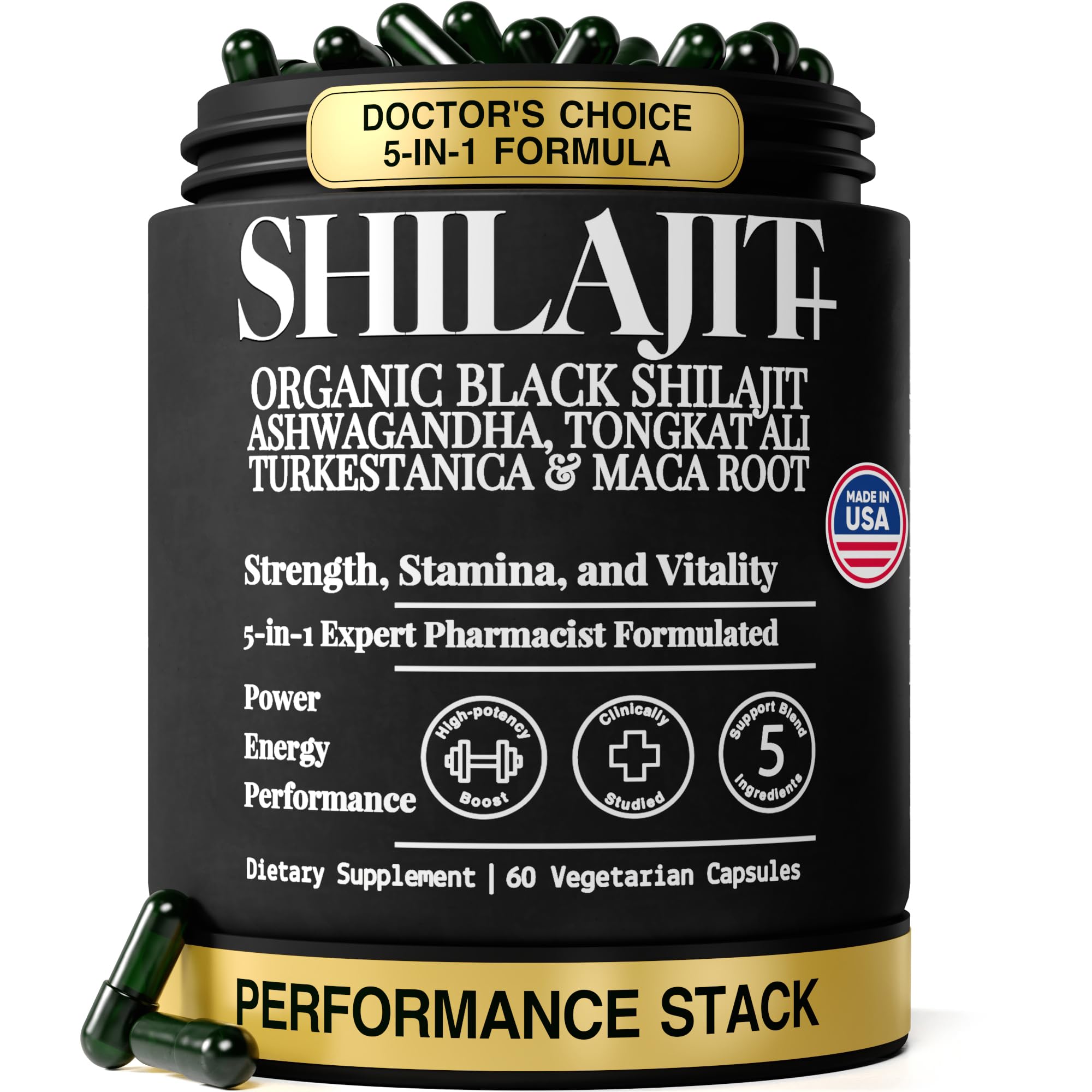
Published research exists for ingredients in this formula — see Related research below. Whether this product’s doses match those studies could not be confirmed.

Highest Potency Black Shilajit for Men – 80% Fulvic…
Marketing check: 4 remain partly or independently unverified.
Rebuilt from public sources on July 23, 2026 · evidence availability is not a safety or effectiveness verdict.
Does the marketing hold up?
Couldn’t verify means public proof was not found; it is not a mark against the product. Ingredient research is not treated as a trial of this exact product.
◐Partly confirmed1
?Couldn’t verify independently3
Facility-level claims can be accurate and still say nothing about this product’s contents. No registration document was located.
“Made in USA” can describe only final bottling. Ingredient-sourcing records were not located for this product.
1 more public-evidence limit
No named laboratory or lot-specific certificate was found for this exact product. No exact brand product page was available for a document check. NSF, IFOS, USP, and Informed-Sport were not checked in this record. This is a public-evidence limit, not a finding that testing did not occur.
What is worth knowing.
Headlines first. Open evidence only when you want the source trail.
Category context: sexual-enhancement products carry documented FDA risk
This is category history, not proof about this product, but it changes how much unsupported claims deserve to be trusted.
Evidence and sources
FDA's health-fraud program documents sexual-enhancement products as the most common supplement category found to contain undeclared prescription-drug ingredients. This is a category-level documented fact from FDA's public database — not a test result for this specific product. So…
Locked evidence record →Open the full source-linked findingEvery declared ingredient has an amount · 5 quantified rows.
You can compare each declared dose with research instead of guessing what is hidden inside a blend.
Evidence and sources
The panel gives a per-ingredient amount rather than hiding quantities inside a proprietary blend, so each one can be compared to published research.
Locked evidence record →Open the full source-linked findingDose and research context
Ingredient context used alongside the captured panel. These sources do not test this product or establish safety or effectiveness.
Want the complete evidence trail?
The summary stops at product-specific facts. The full report preserves every source, calculation, limitation, and unresolved check for review or sharing.
Open the full evidence trailSources, edge cases, and every unresolved check
Confirmed evidence
What checked out01
These checks found support in the public record. They confirm specific facts, not the product as a whole.
Every ingredient amount is disclosed
The panel gives a per-ingredient amount rather than hiding quantities inside a proprietary blend, so each one can be compared to published research.
Documented concerns
What needs caution00
These are documented contradictions or claims that need more evidence. They are separate from missing data.
No contradictions or product-specific cautions were found at this check depth.
Unresolved public record
What is still missing04
We looked for these signals but could not settle them from public sources. A gap is not a strike.
Multi-ingredient formula — panel read, serving weight unknown
We read the full Supplement Facts panel from the listing-image panel (below), but the label doesn’t state a serving weight, so the arithmetic can’t run. A gap in the label’s information, not evidence of a problem.
Research context is available for the listed ingredients
Published sources describe how ashwagandha, tongkat ali, maca root have been studied. This is ingredient context only; the record does not establish that this product delivers the studied dose or outcome. Sources: NIH NCCIH — Ashwagandha, PubMed search: ashwagandha randomized trial.
This category has documented FDA fraud risk
FDA's health-fraud program documents sexual-enhancement products as the most common supplement category found to contain undeclared prescription-drug ingredients. This is a category-level documented fact from FDA's public database — not a test result for this specific product. Source: fda.gov (linked in Related research).
180-day review-count history is on file
Exact-listing history records written-review counts from 37 on 2026-04-10 to 46 on 2026-06-13 (net +9). Count movements can reflect sales, listing variants, collection resets, or moderation; this history does not establish whether reviews are authentic.
What to ask and check
What would settle the open questions
Why is this shown?
Ask the brand or seller
Can you send the certificate of analysis (COA) for the lot number on my bottle?
A real COA names the testing laboratory, the test date, the lot it covers, and what was measured. “Third-party tested” with no document behind it is a marketing sentence.
What is the product’s UPC or GTIN?
The barcode is how a product gets matched to outside records — certification registries, label databases, recall data. Without it, almost nothing can be cross-checked.
Is this label filed with NIH’s Dietary Supplement Label Database (DSLD)?
Filing is voluntary, so absence proves nothing — but a filed label puts the full ingredient table on public record where anyone can read it.
Where are the ingredients sourced, and where is the product manufactured?
“Made in USA” can describe only the final bottling step. Ask which country the actives came from and whether the facility is audited.
Most brands and sellers publish a contact route. A clear answer adds evidence to the record; no answer leaves the question open.
Check for yourself — no one’s permission needed
Compare the panel on the bottle in your hand to the one shown in this record.
Ours was read from listing photos and can contain reading errors. The physical label is the source of truth — if they disagree, tell us and we’ll correct the record.
Check the lot number and expiry on the bottle against any COA you’re given.
A certificate that doesn’t name your lot doesn’t describe what you’re holding.
These are the open questions on this specific record — not a warning about the product, and not a suggestion to buy or avoid it. Getting them answered is how you decide for yourself.
Record built July 23, 2026. Sources: source listing observed at check time · USPTO Trademark Search · Keepa exact-listing history · NIH / published research · certification and regulator records where available. LookCloser publishes evidence and gaps; it does not advise for or against any supplement. Evidence-based corrections welcome.